About the author
Pierre
Dufraisse
Not a coach. Not a therapist.
The rigor of a researcher, the voice of a writer.
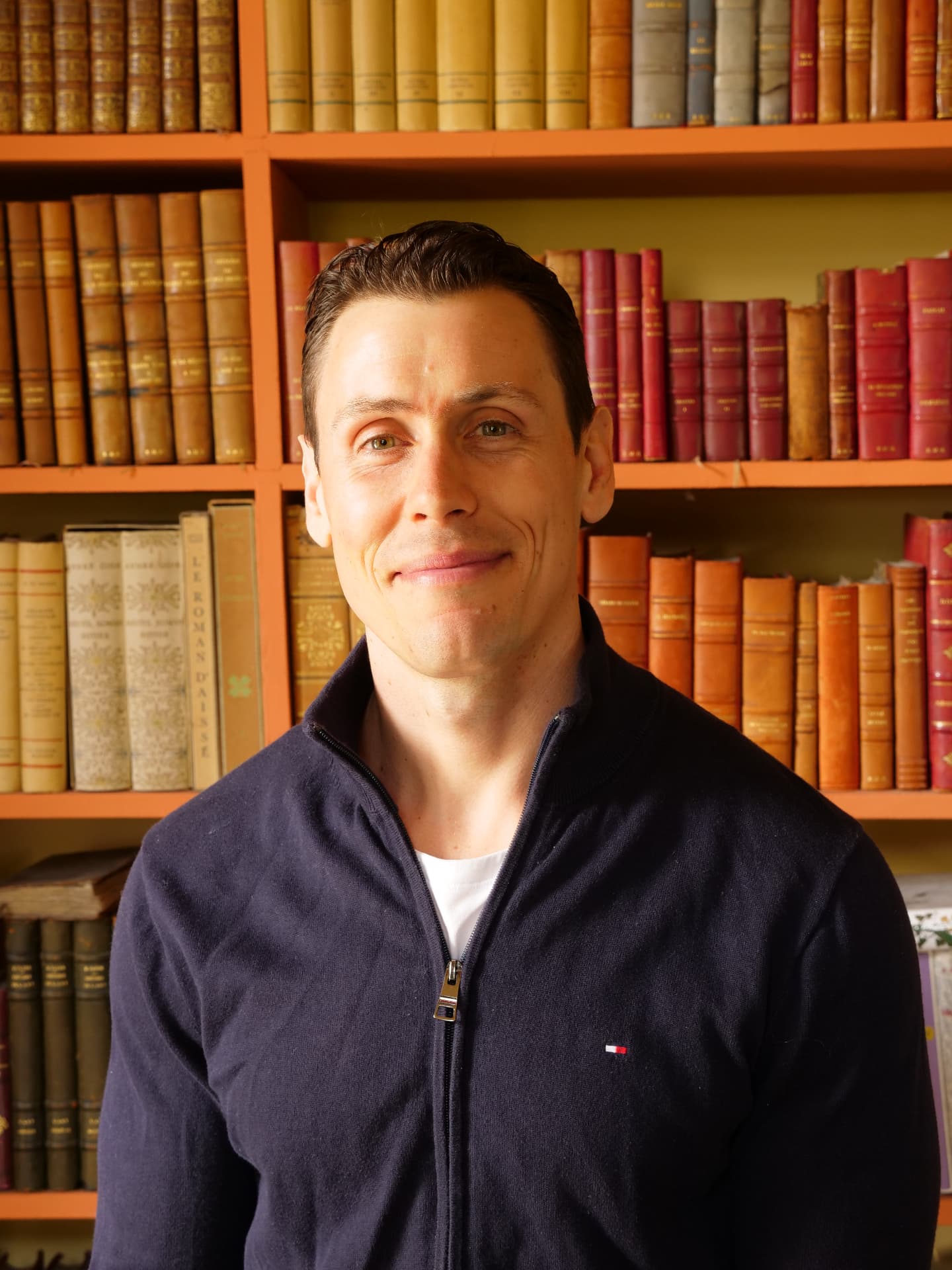
Positioning
Seven years in Japan, several more studying the neuroscience of emotion, and an approach to inner life that is rigorous without becoming clinical.
Pierre Dufraisse is not a coach. He is not a therapist. He is not a speaker with a framework. He spent seven years in Japan, several more studying the neuroscience of emotion, and wrote The Emotional Manual because he could not find the book he was looking for: one that took feelings seriously without turning them into a method.
Living in Japan from 2013 to 2020 changed how Pierre understood emotion. In a culture where the boundary between the presented self, tatemae, and the inner self, honne, is explicit and named, he encountered a different way of relating to what one feels. Not more suppressed, not more authentic, but structured differently. That experience runs through every chapter of the book and gives it a perspective untouched by American therapeutic culture.
Before writing, he spent years inside predictive processing, enactivism, affective neuroscience, and phenomenology. Karl Friston's work on prediction, Francisco Varela's account of enactivism, and Antonio Damasio's writing on the body and decision-making all matter here, but not as academic citations. They appear as living ideas that illuminate everyday emotional experience.
Pierre writes as an essayist, not as a scientist addressing a lab, and not as a guide promising emotional repair. The tone is more intimate than academic psychology, less therapeutic than mainstream vulnerability discourse, more rigorous than most self-help, and far less interested in irony than in clarity.
The Emotional Manual is his first book. It is not a framework. It is not a method. It is an attempt to understand, as clearly as possible, what emotions actually are and why that understanding matters.
The book
A literary approach to the science of feeling, shaped by Japan and written against the reflex to optimize the self.
A different language for inner life
For readers used to the language of emotional intelligence, Pierre's years in Japan open a different horizon. They bring a quieter, more exacting attention to the way feeling is shaped by context, role, embodiment, and silence.
That is why the book can move from the neuroscience of emotion to the texture of an ordinary day without sounding like a lecture or like therapy. The research is there, but it remains in service of perception. The writing stays close to lived experience.
Pierre Dufraisse, author of The Emotional Manual, writes for readers who want to think more clearly about emotion without reducing it to a productivity tool, a healing script, or a brand of self-knowledge.